
Document Digitization & Indexing
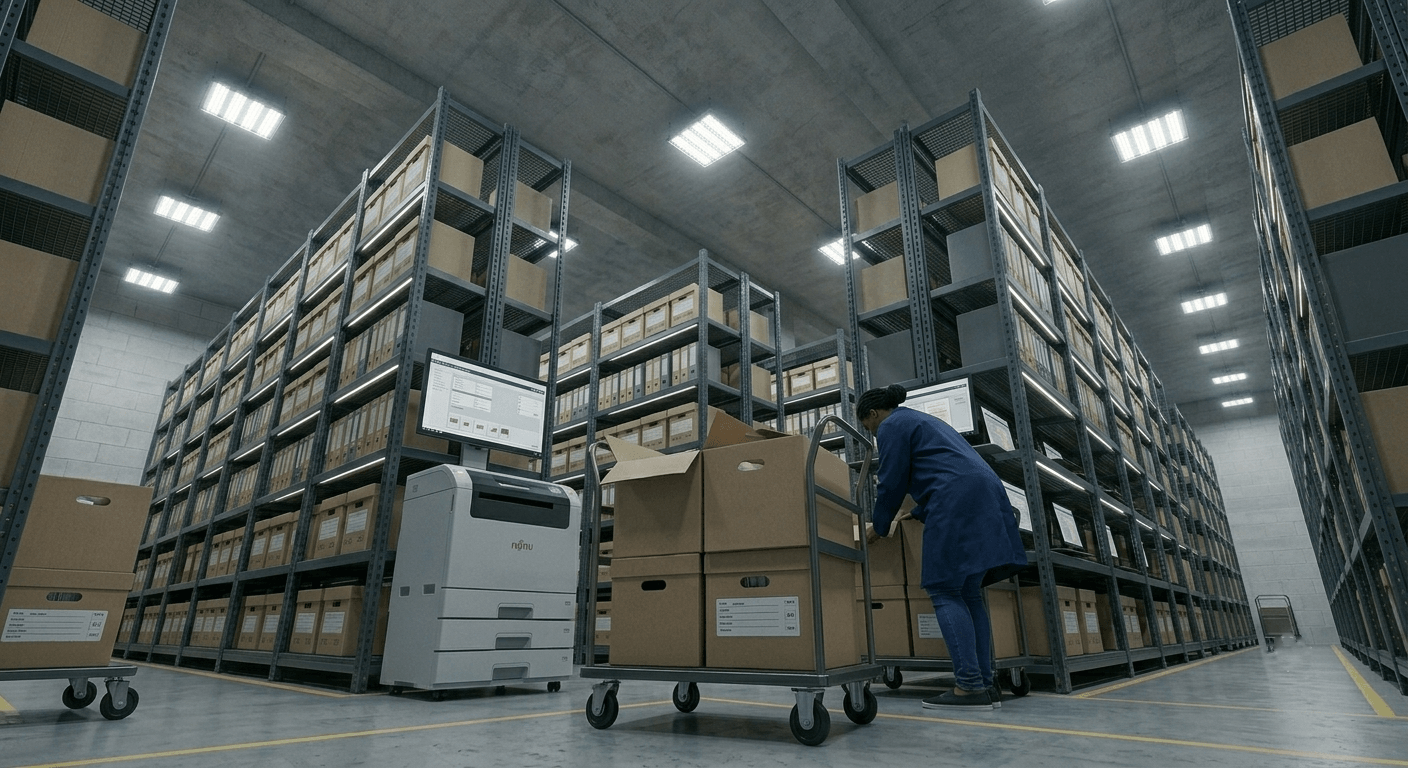
Physical documents remain a cornerstone of business operations across industries. However, relying on paper-based records introduces significant challenges — slow retrieval, risk of loss or damage, and difficulty maintaining compliance in an increasingly digital world. Professional document digitization bridges this gap, converting physical files into searchable digital formats while preserving every detail of the original.
High-resolution scanning combined with Optical Character Recognition (OCR) technology transforms scanned images into fully searchable text. This means documents are not just stored digitally — they become instantly findable through keyword searches, metadata tags, and intelligent categorization. For organizations managing thousands or millions of records, the difference is transformative.
Paper-based record keeping carries hidden costs that many organizations underestimate. A single filing cabinet can hold roughly 10,000 documents, yet the labour required to maintain, retrieve, and refile those documents can consume hundreds of staff hours annually. When an employee spends fifteen minutes walking to a filing room, locating a folder, pulling the correct document, copying it, and returning the file, the cumulative cost across thousands of requests becomes substantial. By contrast, a properly digitized document can be retrieved in under five seconds from any authorised workstation.
Physical storage also imposes a real estate burden. Office space in major metropolitan areas commands premium rates, and archive rooms filled with filing cabinets represent underutilised square footage. Beyond the cost per square metre, there are additional expenses for shelving systems, filing supplies, and climate control to prevent paper degradation. These ongoing operational costs rarely appear as a line item on budgets but silently erode profitability year after year.
Security and compliance present an even greater concern. Paper documents can be removed from premises without a digital trace, misfiled beyond easy recovery, or destroyed in a fire, flood, or theft. Regulatory frameworks such as GDPR, HIPAA, and ISO 27001 increasingly demand demonstrable control over records throughout their lifecycle. Digital records with audit trails provide the chain of custody and access logs that paper systems cannot match, making compliance audits significantly less burdensome.
Disaster vulnerability is another critical factor. A single incident — a burst pipe, an electrical fire, or even a spilled drink — can destroy irreplaceable records. Organisations that rely solely on paper place their operational continuity at risk. Digitisation, combined with off-site backup and cloud replication, ensures that records survive any physical disaster. This resilience is not merely a convenience; it is a cornerstone of business continuity planning.
A professional digitization project follows a structured workflow designed to maintain document integrity, data accuracy, and consistent quality at every stage. The process begins long before any scanner is switched on, with thorough planning and document preparation. Incoming records are first assessed for condition — staples, paperclips, bindings, and adhesive fasteners must be removed to prevent damage to both documents and scanning equipment. Pages are sorted, checked for tears or folds, and arranged in the correct order. Fragile or oversized documents receive special handling, sometimes requiring flatbed scanning rather than automated sheet-feed scanners.
Once prepared, documents proceed to the scanning stage. Production-grade scanners capable of handling hundreds of pages per minute capture images at resolutions typically ranging from 200 to 600 DPI, depending on the document type and the intended use. Colour depth is selected based on content — black-and-white for standard text documents, greyscale for photographs or faded originals, and full colour for maps, charts, and illustrated materials. During scanning, each batch is tracked through barcode separation sheets or patch codes that maintain batch integrity and prevent page mix-ups across large volumes.
Quality control is performed immediately after scanning. Every image is reviewed for legibility, correct orientation, cropping accuracy, and completeness. Pages that fail quality checks — whether due to skewed alignment, shadows from staples, or insufficient contrast — are rescanned immediately. QC operators verify that page counts match the physical batch and that no pages have been missed or duplicated. This layer of verification is what separates professional digitization from bulk office scanning, where errors can go unnoticed until a critical document cannot be found.
With clean images approved, OCR processing converts the visual representation of text into machine-readable character data. The OCR engine analyses each image, identifies regions of text, and applies pattern recognition algorithms to decode letters and numbers. Modern OCR systems achieve accuracy rates exceeding 99% for clean, typed documents in standard fonts. The resulting text layer is embedded into searchable PDF files, allowing users to highlight, copy, and search for any word or phrase within the document as if it had been born digital.
Metadata tagging and indexing follow the OCR phase. Each document is assigned descriptive fields — document type, date, department, project code, client name, and any other categories relevant to the organisation. These tags form the searchable index that enables instant retrieval. Finally, the digitized files undergo data validation, where random samples are cross-checked against source documents to confirm indexing accuracy. Once validated, the digital records are packaged and delivered through the integration method chosen by the client — whether that is a network folder, an FTP transfer, a cloud storage sync, or direct integration with an existing document management system.
Optical Character Recognition is the technology that transforms scanned document images into searchable and editable text. At its core, OCR works by analysing the patterns of light and dark pixels in a scanned image, identifying shapes that correspond to letters, numbers, and symbols. Early OCR systems relied on template matching — comparing each character image against a library of known fonts. Modern OCR engines, however, use machine learning and neural network models that recognise characters based on features such as line curvature, intersection points, and stroke thickness, making them far more adaptable to different typefaces and print qualities.
The OCR process unfolds in several stages. First, the image is pre-processed to improve recognition accuracy — this includes deskewing (correcting angled pages), binarisation (converting to pure black and white), and noise reduction (removing speckles and background artefacts). Next, the engine performs layout analysis to identify text regions, tables, headers, and page numbers, distinguishing body content from marginalia. Character segmentation then isolates individual glyphs, and the recognition engine assigns a character value to each segmented shape. Finally, a language model and dictionary are applied to verify the recognised text, correcting obvious errors based on word context and grammar rules.
Accuracy rates vary depending on the quality of the original document. Clean, typed documents printed on white paper with high-contrast ink typically achieve accuracy rates of 99% or higher at the character level. Documents with unusual fonts, small type sizes, coloured backgrounds, or faded text see lower accuracy, often in the 90% to 98% range. Handwritten text presents the greatest challenge, with accuracy depending heavily on handwriting legibility and the sophistication of the recognition model. Modern intelligent OCR systems can be trained on specific handwriting samples to improve performance for specialised applications such as medical notes or historical archives.
Professional digitization services account for these variables by selecting appropriate scanning parameters and OCR configurations for each document type. Poor quality originals may be scanned at higher resolutions (up to 600 DPI) to give the OCR engine more pixel data to work with. Contrast adjustments, adaptive thresholding, and manual zone definition can further improve results on challenging documents. When OCR confidence falls below a configurable threshold, the system flags those pages for manual verification, where a human operator reviews the recognised text and corrects any errors before the document is finalised. This human-in-the-loop approach ensures that even problematic originals yield accurate, reliable digital text.
Scanning and OCR produce a digital image with searchable text, but without a structured index, finding a specific document among thousands is like searching for a book in a library without a catalogue. Intelligent indexing provides that catalogue — a metadata framework that organises documents by meaningful attributes such as date ranges, document categories, client identifiers, project codes, or any other classification that matches the organisation's operational needs. The quality of this indexing layer directly determines how effectively users can locate, filter, and manage their digital records.
Metadata strategy begins with taxonomy design — defining the categories, hierarchies, and naming conventions that will be applied across the document set. A well-designed taxonomy balances granularity with usability. Too few categories and searches return too many results; too many categories and the indexing process becomes impractical and inconsistent. For example, an accounting department might need metadata fields for invoice number, vendor name, date, amount, purchase order reference, and approval status. A legal firm, by contrast, might require fields for case number, document type, jurisdiction, party names, and privilege status. The taxonomy must be tailored to each client's specific workflows and retrieval patterns.
Indexing can be performed through auto-classification, manual tagging, or a hybrid approach. Auto-classification uses rules and pattern matching to assign metadata automatically — for instance, recognising an invoice by its layout and extracting the invoice number and date from known positions on the page. This approach is fast and consistent for standardised document types but may struggle with irregular or complex documents. Manual tagging relies on trained indexers who review each document and assign metadata based on its content and context. Manual indexing is more flexible and accurate for diverse document sets but is slower and more expensive. The hybrid approach leverages auto-classification as a first pass, with manual review applied to documents that fall below a confidence threshold, balancing speed with accuracy.
The impact of good indexing on searchability cannot be overstated. A full-text search across OCR output can find any word that appears in the document body, but it cannot distinguish between a passing mention and a key subject. Metadata-based filtering allows users to narrow results by document type, date range, author, or department before even entering a keyword. Advanced search interfaces combine full-text and metadata queries, enabling searches like "find all invoices from vendor X, dated Q2 2025, with amounts exceeding $10,000" that return precise results in seconds. This level of search sophistication transforms a digital archive from a static repository into an active information asset.
- Rapid Retrieval: Find any document in seconds through full-text search and filtered queries, eliminating hours of manual file-pulling. Staff productivity improves immediately when the time spent hunting for physical files is reallocated to value-adding work.
- Space Savings: Free up valuable office space by reducing or eliminating physical storage cabinets and archive rooms. A single hard drive can replace dozens of filing cabinets, releasing floor space for revenue-generating or collaborative uses.
- Disaster Protection: Digital records can be backed up off-site or to the cloud, protecting against fire, flood, or theft. With redundant copies stored across geographically diverse locations, document loss becomes a near impossibility.
- Compliance Readiness: Digital records with audit trails make regulatory compliance and audit preparation straightforward. Every access, modification, and deletion is logged, providing demonstrable evidence of proper records management for regulators and external auditors.
- Improved Collaboration: Digital documents can be accessed simultaneously by multiple users across different locations. Teams no longer need to queue for a single physical file, and remote workers gain the same access as in-office staff, enabling seamless collaboration regardless of geography.
- Remote Access: A cloud-based digital archive allows authorised personnel to access documents from any device with an internet connection. Field workers, travelling executives, and remote teams stay productive without needing to return to the office to retrieve physical files.
- Cost Savings Over Time: While digitization requires an upfront investment, the long-term savings from reduced storage costs, lower labour overhead, faster retrieval, and eliminated supply purchases (folders, binders, labels, toner) typically deliver a positive return on investment within twelve to eighteen months.
- Environmental Benefits: Reducing reliance on paper lowers an organisation's environmental footprint. Fewer trees consumed, less energy spent on paper production and transport, and reduced waste sent to landfill all contribute to corporate sustainability goals and environmental reporting.
SwiftFiles Solution offers end-to-end digitization services — from document preparation and high-resolution scanning to metadata tagging and integration with your existing document management systems. Whether you need to digitise a single cabinet or an entire warehouse, our scalable processes deliver consistent, high-quality results. Our team works closely with your stakeholders to design a metadata taxonomy that aligns with your operational workflows, and we validate every batch to ensure that the digital records you receive are accurate, complete, and immediately usable.
We serve clients across a wide range of industries, including legal, financial services, healthcare, government, education, and logistics. Each sector presents unique challenges — from the strict confidentiality requirements of legal records to the retention schedule complexities of financial documents — and our digitization process is flexible enough to handle them all. We also provide ongoing support after digitization, including integration assistance, staff training on your document management system, and advice on digital retention policies and disposal schedules for the now-redundant physical records.
Making the transition from a paper-dependent operation to a digitally-enabled one is not simply a technology upgrade; it is a fundamental improvement in how an organisation manages its information assets. When documents are digitised, indexed, and integrated into daily workflows, the return on investment extends beyond cost savings to encompass faster decision-making, reduced risk, and a more agile, responsive business. The path to digital transformation begins with the decision to digitise, and the organisations that take that step position themselves strongly for the future.
Ready to Digitize Your Records?
Contact us to discuss your digitization project and get a customized proposal.
Get in Touch