
Secure Physical & Digital Storage
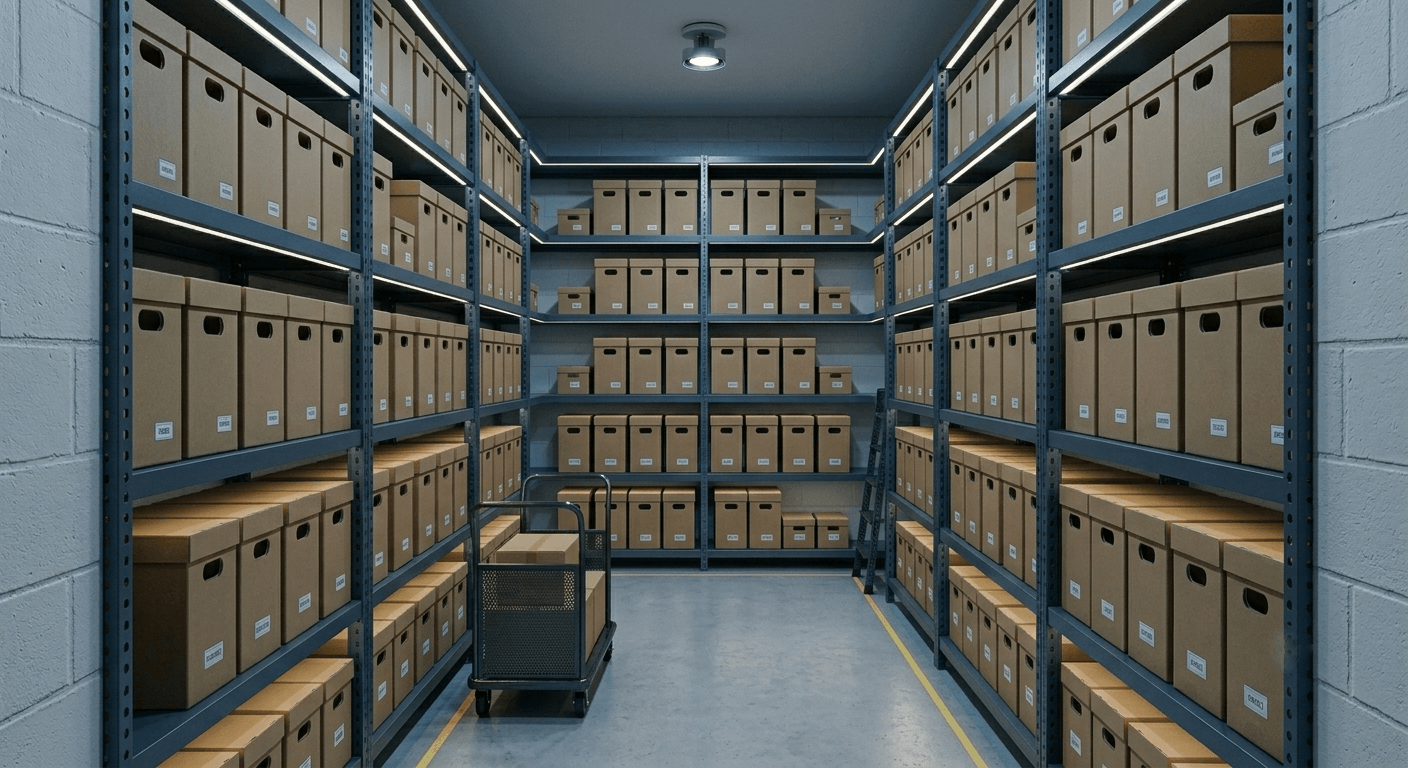
Protecting sensitive records is one of the most critical responsibilities for any organisation. Whether physical documents or digital assets, a robust storage strategy must address security, accessibility, and long-term preservation. SwiftFiles Solution provides secure storage solutions for both physical and digital records, ensuring your information remains protected, organised, and accessible whenever needed.
Not all records require the same level of accessibility or storage environment, which is why a tiered storage strategy is essential. SwiftFiles organises records across three primary tiers — active, semi-active, and archival — each designed to balance cost, security, and retrieval speed according to the record's lifecycle stage. Active storage accommodates documents referenced frequently in daily operations, kept on-site or in near-line digital repositories for instant access. Semi-active storage holds records that must be retained for compliance or occasional reference but no longer require immediate availability. Archival storage is intended for long-term preservation of records with infrequent or statutory retention requirements, prioritising security and environmental stability over rapid retrieval.
Determining which tier is appropriate depends on factors such as regulatory retention periods, operational reliance on the information, and the legal implications of record loss. SwiftFiles conducts a thorough records audit with each client to classify documents and map them to the optimal storage tier, ensuring that frequently accessed materials are not occupying premium space reserved for long-term preservation. This classification process also identifies records eligible for digitisation, allowing organisations to reduce their physical footprint while maintaining full compliance.
SwiftFiles' tier management is dynamic rather than static. As records age or business needs change, documents can be migrated between tiers seamlessly. A contract file, for example, may begin in active storage during the negotiation and execution phase, move to semi-active storage once the agreement is in force, and finally transition to archival storage after the contract expires and the statutory retention period begins. Automated workflows within SwiftFiles' management platform trigger these transitions, alerting administrators when records are due for migration and ensuring that no document languishes in the wrong tier. Each migration is logged with a timestamp and operator identifier, creating a complete chain of custody throughout the record's lifecycle.
Cost efficiency is a key benefit of tiered storage. Maintaining all records in premium active storage is unnecessarily expensive, while relegating important operational documents solely to archival storage can impede productivity. SwiftFiles helps organisations right-size their storage expenditure by aligning each record with the most cost-effective tier that still meets security and accessibility requirements. Regular reviews are conducted to ensure the tier assignment remains appropriate, and clients receive detailed reporting on storage utilisation and cost allocation across all tiers.
SwiftFiles' certified storage facilities are purpose-built to meet the highest standards of document preservation and security. Climate-controlled environments maintain temperature ranges of 18–22℃ (64–72℉) and relative humidity between 35–45%, the internationally recognised optimal conditions for paper-based records. These parameters prevent the common deterioration mechanisms that plague improperly stored documents — including fungal growth, ink fading, embrittlement, and pest infestation. Continuous environmental monitoring systems track conditions in real time, with automated alerts triggered if readings deviate outside acceptable thresholds. Backup HVAC systems with redundant compressors and power supplies ensure that climate control remains operational even during equipment failure or utility outages.
Fire protection in SwiftFiles facilities employs a multi-layered approach. Pre-action dry-pipe sprinkler systems are installed throughout storage areas, requiring both heat detection and sprinkler head activation before water is released, virtually eliminating the risk of accidental water damage. In server and media storage rooms, inert gas suppression systems using argon or nitrogen displace oxygen to extinguish fires without harming sensitive equipment or documents. Early warning smoke detection systems utilise aspirating technology that draws air samples into highly sensitive laser-based detectors, identifying combustion particles at the earliest possible stage. These fire protection measures are inspected and tested monthly, with full system certifications renewed annually in accordance with NFPA standards.
Water damage prevention extends beyond fire suppression. Facilities are constructed with raised floors in document storage areas, providing a minimum of 15 centimetres of clearance above potential flood levels. Water leak detection cables are installed along baseboards and beneath shelving units, connected to central monitoring systems that instantly alert facility management to any moisture presence. Stormwater drainage systems are designed for 100-year flood event capacity, and all critical storage areas are located above ground level. Pest management follows an integrated approach combining exclusion, monitoring, and targeted treatment. Sealed building envelopes, insect-proof lighting fixtures, and regularly inspected perimeter barriers prevent pest entry, while pheromone traps and glue boards are placed throughout storage areas and inspected on a scheduled basis.
Building security encompasses perimeter protection, access control, and comprehensive surveillance. The facility perimeter features reinforced concrete walls, anti-ram vehicle barriers at entry points, and intrusion detection systems covering all doors, windows, and service accesses. Access control is enforced through multi-factor authentication at every entry point, combining biometric fingerprint or iris scanners with PIN-code keypads and proximity card readers. Access permissions are configured on a role-specific basis, with access logs reviewed daily for unusual patterns. Closed-circuit television coverage provides 360-degree surveillance of all storage areas, corridors, entry points, and loading docks, with high-resolution cameras capable of identifying facial features and document-level details. Footage is retained for a minimum of 90 days and stored on encrypted network video recorders in a separate secured location.
Document handling protocols are equally rigorous. All materials received at SwiftFiles facilities are logged into the inventory management system upon arrival, with barcode labels applied to each box and individual file folder. Handling is restricted to trained personnel who have undergone background checks and signed confidentiality agreements. Access to stored materials is granted only upon verified authorisation from the client, with each retrieval, return, or inspection recorded with timestamps and handler identity. Transportation of documents within the facility occurs in locked, tracked carts that follow designated secure pathways, and any temporary staging areas are under continuous video surveillance. These protocols ensure that the chain of custody is maintained without interruption from the moment documents arrive until they are returned to the client or authorised for destruction.
SwiftFiles' digital storage infrastructure is built on a foundation of enterprise-grade server systems designed for reliability, scalability, and security. Our data centres employ a highly available architecture with N+1 redundancy across all critical components, including power supplies, network links, cooling systems, and storage controllers. Server hardware is refreshed on a three-year lifecycle to ensure consistent performance and security patch currency. Storage area networks (SAN) utilise tiered flash and spinning-disk configurations that automatically place frequently accessed data on high-performance solid-state drives while migrating colder data to more economical hard disk storage, optimising both speed and cost.
Encryption safeguards data at every stage of its lifecycle. At rest, all stored data is encrypted using AES-256-bit encryption, the current standard approved by governments and financial institutions worldwide for protection of classified and sensitive information. Encryption keys are managed through a dedicated hardware security module (HSM) that enforces strict key rotation policies and prevents unauthorised key export. In transit, data is protected by TLS 1.3 protocol for all network communications, ensuring that any data moving between client systems, SwiftFiles platforms, and backup locations is cryptographically secured against interception. Additional layer encryption is applied for data replication between data centres, using separate encryption keys from those used for data at rest to provide defence in depth.
Redundancy and backup strategies follow the industry-standard 3-2-1 rule: at least three copies of data, stored on two different media types, with at least one copy stored off-site. SwiftFiles extends this principle by maintaining geographically dispersed data centres located in separate seismic and flood zones, connected by redundant private fibre networks. Automated backup jobs run on a schedule customised to each client's recovery requirements, with options for hourly, daily, weekly, and monthly snapshots. Full backups occur weekly with incremental backups running between full backup cycles, minimising storage consumption while ensuring recoverability. Every backup is verified through automated integrity checks, and a sample of backups is subjected to full restoration testing each quarter to validate recoverability.
Cloud versus on-premise storage decisions are evaluated on a client-by-client basis, considering regulatory requirements, budget constraints, and operational preferences. SwiftFiles offers both private cloud deployments hosted in dedicated virtual private cloud environments and on-premise appliance options for organisations that require data to remain within their own infrastructure. Hybrid configurations are also supported, allowing clients to maintain active data on local appliances for low-latency access while leveraging cloud storage for backup and archival purposes. Regardless of deployment model, the same security controls and management interfaces apply, providing a consistent operational experience.
Access control within digital systems adheres to the principles of Role-Based Access Control (RBAC) and least privilege. User permissions are granularly defined at the document, folder, and system function levels, ensuring that each user has access only to the records and operations necessary for their role. Permission groups are configurable by the client's own administrators through SwiftFiles' management portal, allowing organisations to maintain control over their own access policies without requiring intervention from SwiftFiles staff. All access events — including logins, document views, downloads, modifications, and permission changes — are recorded in immutable audit logs that cannot be altered or deleted by any user, including system administrators. These logs are available for export and integration with client security information and event management (SIEM) systems for centralised monitoring.
SwiftFiles maintains compliance with a comprehensive suite of international standards and regulatory frameworks to ensure that storage practices meet or exceed industry requirements. Our information security management system is aligned with ISO/IEC 27001 principles, covering risk assessment, security controls, incident management, and continuous improvement. Quality management processes follow ISO 9001 guidelines, ensuring consistent service delivery and client satisfaction measurement. For clients in regulated industries, we also align with sector-specific standards including HIPAA for healthcare records, GDPR for personal data of EU residents, and the Sarbanes-Oxley Act for financial record retention. Our compliance team monitors regulatory changes continuously and updates policies and procedures to reflect new requirements.
Document retention compliance requires organisations to navigate a complex landscape of statutory and regulatory requirements that vary by jurisdiction, industry, and document type. SwiftFiles' retention management module enables clients to define retention policies at the document class level, with automated enforcement of minimum retention periods and legally mandated destruction holds. When a retention period expires, the system initiates a review workflow that notifies designated stakeholders before any destruction action proceeds, preventing accidental disposal of records that may be subject to litigation holds or regulatory investigations. The system also generates retention compliance reports that can be presented to auditors or regulatory bodies as evidence of proper records management practices.
Audit trail integrity is fundamental to SwiftFiles' platform. Every action performed on a record — from creation and classification through storage, access, modification, migration, and destruction — is recorded in a tamper-evident audit log. The audit log includes the action timestamp, the identity of the person or system that performed the action, the previous and new values of any changed metadata, and the IP address or workstation identifier from which the action originated. Logs are written to write-once-read-many (WORM) storage that prevents any subsequent modification or deletion, and cryptographic hash chaining ensures that any attempt to alter historical log entries would be immediately detectable. These audit trails satisfy evidentiary standards for legal proceedings and regulatory inquiries.
Data sovereignty considerations are increasingly important as governments enact laws requiring that certain categories of data remain within national borders. SwiftFiles addresses this through a federated data centre model that allows clients to select the geographic region where their data will be stored. Data centre locations are available across multiple continents, with each facility operating under the legal jurisdiction of its host country. Clients can specify data residency requirements in their service agreement, and our platform enforces these restrictions at the infrastructure level, preventing data from being transferred outside the designated jurisdiction. For multinational organisations, SwiftFiles supports multi-region deployments where data is segregated by jurisdiction while still being manageable through a unified administrative interface.
A comprehensive disaster recovery strategy ensures that SwiftFiles can maintain operations and protect client data even in the face of significant disruptions. Our business continuity plan addresses a wide range of scenarios including natural disasters (earthquakes, floods, severe weather), infrastructure failures (power outages, network disruptions, hardware malfunctions), security incidents (cyberattacks, unauthorised access), and public health emergencies. The plan is reviewed and updated quarterly, with formal tabletop exercises conducted semi-annually to validate procedures and identify improvement opportunities. All staff receive role-specific training on their responsibilities during an incident, and critical functions are cross-trained across multiple team members to mitigate the impact of personnel unavailability.
Backup schedules are tailored to the criticality and volatility of each data set. Core transaction databases and active document repositories are backed up every four hours, with transaction log shipping providing near-real-time replication to the secondary data centre. Less frequently modified data, such as archival records and completed project files, is backed up daily. Weekly full backups are retained for 90 days, monthly full backups for one year, and annual full backups for the duration of the client agreement plus seven years, ensuring that data can be recovered from historical points in time if needed for legal discovery or regulatory investigation. All backup media are encrypted and transmitted over dedicated circuits to the off-site facility, where they are stored in a fire-rated, climate-controlled vault separate from the primary storage environment.
Recovery Time Objectives (RTO) and Recovery Point Objectives (RPO) are defined in consultation with each client to align with their business requirements. For critical systems, SwiftFiles targets an RTO of four hours or less — meaning that systems and data should be fully operational within four hours of a declared disaster — and an RPO of one hour or less, ensuring that no more than one hour of data is lost in the event of a failure. Standard systems carry an RTO of 24 hours and an RPO of 24 hours. These objectives are documented in each client's service level agreement and are subject to regular testing to confirm achievability. In the event that testing reveals a capability gap, remediation plans are developed and implemented before the next test cycle.
Disaster recovery testing is conducted on a quarterly cycle, rotating between different failure scenarios to ensure comprehensive coverage. Tests include simulated data centre outages, network segmentation failures, ransomware attack containment, and prolonged regional power loss. Each test follows a structured methodology: scenario definition, test execution with live failover, validation of data integrity and application functionality, failback to primary systems, and a post-test review documenting lessons learned and action items. Test results are documented in formal reports that are shared with clients upon request, providing independent validation that SwiftFiles' disaster recovery capabilities meet the promised standards.
SwiftFiles also maintains reciprocal arrangements with third-party colocation facilities for emergency capacity, ensuring that physical storage space and digital processing capability can be scaled rapidly if a disaster affects a primary facility. These arrangements are governed by pre-signed agreements that specify service levels, security requirements, and escalation procedures, eliminating the delays that would occur if such agreements needed to be negotiated under the pressure of an active incident. Contact lists, vendor agreements, and critical documentation are maintained in a secure digital vault accessible from any location, ensuring that the disaster recovery team has the information they need even if primary communication systems are unavailable.
The risks of inadequate storage extend far beyond the inconvenience of a misplaced file. Physical records stored in uncontrolled environments are vulnerable to deterioration from temperature fluctuations, humidity extremes, light exposure, and biological agents such as mould, insects, and rodents. A single flood or fire incident in an unprotected facility can destroy decades of records in minutes, potentially resulting in irretrievable loss of historical data, legal liabilities for failure to produce required documents, and significant operational disruption while records are reconstructed or replaced. For digital records, risks include hardware failure, software corruption, cyberattack, accidental deletion, and format obsolescence. Without professional management, these risks accumulate silently until a failure event occurs, at which point the damage is often already done.
The financial case for professional storage is compelling when examined through a total cost of ownership lens. While self-managed storage may appear less expensive in direct outlay, it typically incurs hidden costs that far exceed professional service fees. These include the capital expenditure of shelving, filing cabinets, climate control equipment, and security systems; the ongoing operational costs of floor space, utilities, insurance, and labour for filing and retrieval; and the opportunity cost of staff time spent managing records instead of performing core business functions. Studies consistently show that organisations can reduce their records management costs by 30–50% by transitioning from self-managed storage to professional services, primarily through economies of scale, specialised expertise, and elimination of redundant or obsolete records through systematic retention scheduling.
Long-term preservation of physical and digital records presents challenges that intensify over time. Paper documents printed on acidic paper — standard for most of the 20th century — undergo chemical degradation that causes yellowing, embrittlement, and eventual disintegration within 25–100 years depending on storage conditions. Even acid-free and archival-quality papers require strict environmental controls to prevent deterioration over decades. Digital records face the equally daunting challenge of format and media obsolescence: a file stored on a 5.25-inch floppy disk or in a WordStar format from 1985 would be essentially inaccessible with modern equipment. Professional storage services address these challenges through environmental controls that slow chemical degradation of physical records and through active format migration programs that ensure digital records remain accessible as technology evolves.
Professional storage also delivers intangible but significant benefits in organisational efficiency and risk management. When records are professionally managed, employees spend minutes rather than hours locating needed information, and they can be confident that the documents they retrieve are the correct, most current versions. The discipline of professional records management — systematic classification, retention scheduling, and destruction — also reduces the volume of records an organisation maintains, cutting storage costs while simultaneously reducing legal discovery exposure in litigation. For organisations that have experienced a compliance audit, regulatory inspection, or legal proceeding, the value of demonstrable records management practices becomes immediately apparent, often making the difference between a clean audit opinion and substantial penalties.
Ultimately, professional storage is an investment in organisational resilience and peace of mind. SwiftFiles Solution partners with clients to develop storage strategies that are tailored to their specific risk profile, regulatory landscape, and operational needs, providing the infrastructure, expertise, and processes necessary to protect their records for the long term. Whether through physical storage in our certified facilities, digital archiving on our secure platforms, or a hybrid approach that combines both, we ensure that every record is stored, secured, and managed to the highest professional standards.